
The Invisible Architecture of Thought
Language is often taken for granted. We use it to order coffee, tell stories, and argue our points—but beneath these everyday functions lies something far more profound. Language doesn’t merely describe the world; it structures it. It frames how we perceive time, color, emotion, and even morality. Linguists, psychologists, and philosophers have long debated this relationship between words and thought, yet evidence continues to suggest that our languages act as invisible architects of our reality.
Every language encodes a unique worldview. When we speak, we’re not just transmitting information—we’re participating in a shared mental model of existence. A speaker of English, Mandarin, or Navajo does not simply express the same idea in different words; they may actually conceive of the world in fundamentally different ways because their language guides their cognition, attention, and memory in distinct patterns.
This idea, though controversial at times, forces us to reconsider the power of language—not as a neutral tool, but as a living framework shaping the contours of human experience.

The Sapir-Whorf Hypothesis: Language as a Lens
The notion that language influences thought is often traced to early 20th-century linguists Edward Sapir and Benjamin Lee Whorf. Together, their ideas formed what is now called the Sapir-Whorf Hypothesis or the principle of linguistic relativity. Whorf, who studied the Hopi language, argued that its lack of certain temporal markers—such as past, present, and future tense—implied that Hopi speakers experienced time differently from English speakers.
Although Whorf’s specific claims were later criticized or refined, his central insight remains influential: the structure and vocabulary of a language affect how its speakers conceptualize reality. This idea has evolved into two main interpretations—linguistic determinism, the stronger claim that language dictates thought, and linguistic relativity, the milder claim that language influences thought. While few modern linguists support strict determinism, there is growing empirical evidence for relativity.
Research in cognitive science has revealed that linguistic categories can subtly, yet powerfully, guide perception. Language, then, acts not as a prison of thought, but as a lens through which the world comes into focus.
Seeing Color, Naming Reality
One of the most striking examples of linguistic relativity comes from color perception. To an English speaker, “blue” is a single color category with many shades—navy, sky, cobalt, teal. But in Russian, there are two distinct words: goluboy for light blue and siniy for dark blue. Studies have shown that Russian speakers are faster at distinguishing between shades of blue that cross this linguistic boundary than English speakers are.
Similarly, in the Himba tribe of Namibia, the color system divides the spectrum differently. They may group what we call green and blue under one term but distinguish multiple shades of green we would never separate. As a result, members of the Himba tribe are better at distinguishing fine variations in green than English speakers, but slower at distinguishing between blue and green.
Time: A Matter of Perspective
Beyond colors, language also molds our perception of time—a concept we often think of as universal. Yet even something as seemingly objective as time flows differently depending on the words used to describe it.
In English and most European languages, time is conceptualized spatially, running from left to right, mirroring our writing direction. Mandarin, however, frequently uses vertical metaphors—“the next month” is described as “down month,” while the previous month is “up month.” In the Aymara language, spoken in parts of the Andes, the past is conceptualized as being in front of the speaker (because it is known and visible), while the future lies behind (because it is unknown).
Gendered Worlds: How Grammar Shapes Thought
Grammatical gender offers another window into how language molds thought. In languages like Spanish, French, or German, every noun is assigned a gender—masculine, feminine, or sometimes neuter. This feature might seem arbitrary, but it can shape how speakers personify or emotionally perceive objects.
For example, in German, the word for “bridge” (die Brücke) is feminine, while in Spanish (el puente) it is masculine. When asked to describe a bridge, German speakers often used adjectives like “beautiful” or “elegant,” whereas Spanish speakers preferred “strong” or “sturdy.” These associations emerge unconsciously, showing how grammatical structures can color our intuitions about the world.
The Power of Words in Emotion and Identity
Language also mediates how we experience and express emotions. Studies have shown that bilingual individuals often report feeling differently when discussing personal topics in one language versus another. A Spanish-English bilingual might describe love as passionate and poetic in Spanish but more pragmatic in English. This is not simply a matter of vocabulary—it reflects how emotional norms and cultural scripts are encoded into linguistic frameworks.
Moreover, certain languages possess words for emotions that others entirely lack. The Portuguese word saudade captures a deep, nostalgic longing for something absent, while the Japanese amae expresses the pleasurable feeling of dependency or being cared for. English has no direct equivalents, and thus these emotional nuances can be difficult to fully articulate or even recognize without the linguistic tools to name them.

Thought Without Words: The Boundaries of the Linguistic Mind
If language shapes thought, does that mean we cannot think beyond it? The answer is complex. Humans are capable of visual, musical, and sensory thought that doesn’t depend on words—artists, mathematicians, and even infants think in patterns, sounds, and images. Yet when it comes to abstract reasoning, memory organization, and communication, language becomes the scaffolding of cognition.
Consider how we use words to construct arguments, define concepts, or plan for the future. Without linguistic structures, these forms of thinking become much harder to manage. Language provides a framework for categorization, allowing us to bundle experiences into coherent concepts. It gives structure to chaos, making thought portable, shareable, and analyzable.
When Language Meets Culture: The Web of Reality
Language and culture are intertwined threads in the fabric of human reality. A language evolves to fit the needs, environment, and values of its speakers, while those speakers in turn are shaped by its patterns. The Inuit, for example, have multiple words for different types of snow, reflecting the environmental importance of distinguishing them. In contrast, speakers of tropical languages may have elaborate vocabularies for rain, wind, or plant life.
These linguistic distinctions reveal that words are not arbitrary labels—they emerge from a culture’s intimate relationship with its surroundings. When languages die, as they do at an alarming rate, unique ways of seeing and describing the world vanish with them. Each lost language represents not just a communication system but a worldview extinguished—a universe of ideas that will never be thought again in quite the same way.
The Digital Age and the New Linguistic Frontier
In the modern world, language continues to evolve rapidly, especially under the influence of technology. Online communication has created new dialects, abbreviations, and emoji-based expressions that reshape emotional nuance and tone. A simple “.” at the end of a text can signal formality, distance, or even passive aggression, depending on context.
Meanwhile, artificial intelligence systems trained on language data now generate texts, simulate conversation, and even learn to predict human emotion—all by analyzing linguistic patterns. This new frontier raises questions: If machines learn to “speak” like us, will they also begin to think like us? Or will their linguistic structures—coded by algorithms—generate entirely new forms of cognition, alien to human experience?
Beyond Words: The Responsibility of Speech
Understanding that language shapes reality also highlights our ethical responsibility as speakers. Words can define social groups, create divisions, or inspire unity. The metaphors we use—“war on drugs,” “illegal alien,” “climate crisis”—frame how societies act. A single linguistic choice can direct public emotion and policy.
Philosophers like Ludwig Wittgenstein captured this power succinctly: “The limits of my language mean the limits of my world.” When we expand our linguistic repertoire, we expand our capacity to understand and empathize. Conversely, when language narrows—through censorship, propaganda, or neglect—our world becomes smaller, simpler, and less humane.To speak, then, is to shape the possible. The more consciously we use language, the more consciously we build the world we inhabit.
Conclusion: Thinking Through Words, Living Through Language
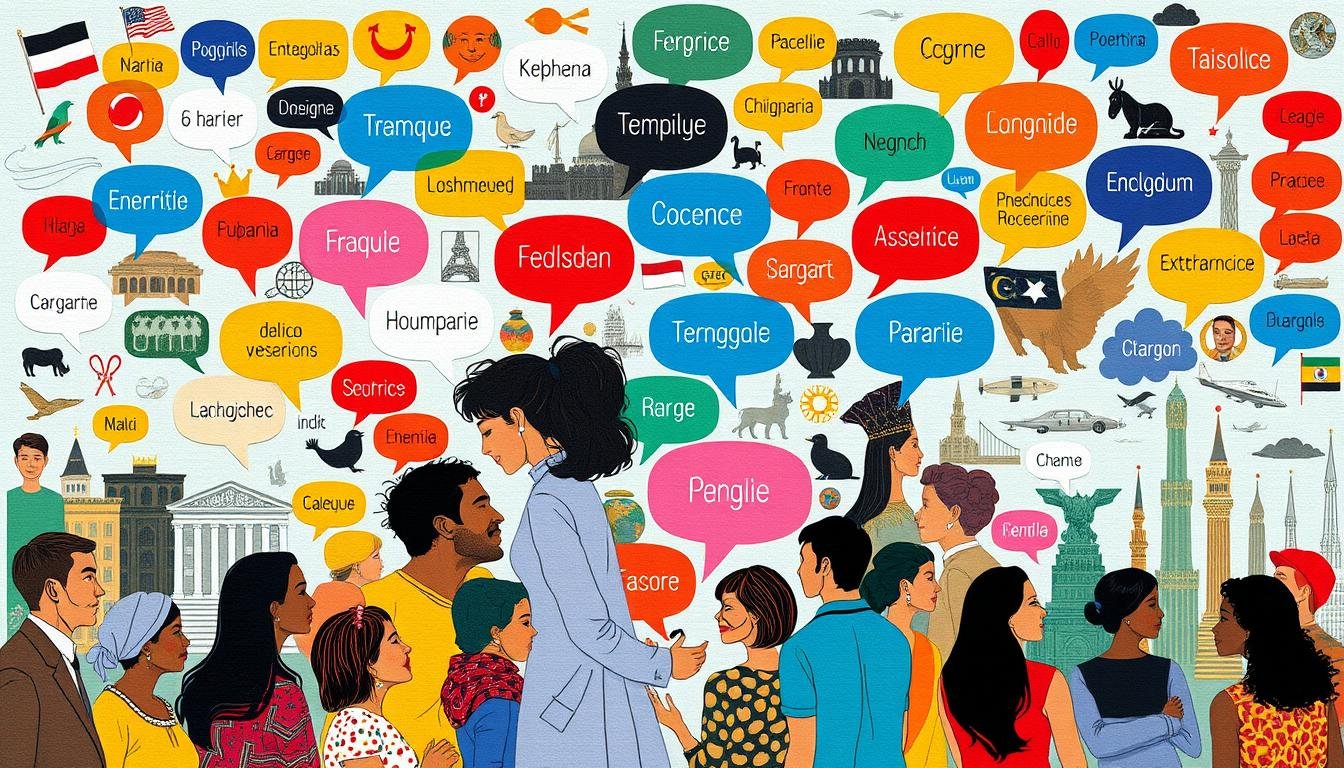
Language is not merely a system of grammar and vocabulary—it is the architecture of perception, the skeleton of culture, and the mirror of human consciousness. It shapes what we see, how we feel, and what we believe to be real. Every language, in its structure and rhythm, carries a philosophy of existence, and every speaker unconsciously absorbs it.
To go beyond grammar is to realize that words are not neutral—they are creative forces. They build bridges between minds, construct social realities, and define the contours of human thought. When we explore new languages or rethink the ones we use, we are not just learning new words—we are rediscovering the infinite ways to see and be in the world.


 0
0
 0
0